An Apology.

You know, it used to take a lot to get me angry. Someone would literally have to be standing on my neck before I’d respond in kind. Then one day, I was introduced to the internet, and I’ve been flipping tables ever since.

With that said, I apologize for raging out, Maria Lloyd. I let my emotions get the best of me. I blew up your mentions on Twitter. I said your essay was “irresponsible, irrelevant, and incorrect.” I suggested that you pursue another profession. I said that shaming single mothers for page hits under the guise of fake concern was the equivalent of shitting in someone’s mouth, You Tubing it, and asking for a tip after. Before I came for your neck, I went after your colleague (and co-writer of this post), Dr. Boyce Watkins, calling him a “misogynistic, foot-shuffling moron” for pimping black pathology porn. I also called him a “bully, a fraud, and a hack” and laughed when someone said he was “a doctor of fuck shit and Crown Royal bags.” I feel awful because that’s an insult to real doctors of fuck shit and Crown Royal bags. And I really shouldn’t have told you to seek another profession because we need people like you, Dr. Watkins, and other professional black pathology pimps (Hi, Jason Whitlock!) to be shining examples of what not to do.

It’s important, Maria Lloyd, that you remain here on the front lines, parroting patriarchal bullshit like “ERMAGERD THE BLACK FAMILY IS IN SHAMBLES BECAUSE YOU’RE A FILTHY WHORE” because that’s what we need. We don’t need better policies that ensure the success of Ms. Fields or women like her. We don’t need to offer genuine support. No, no. We just need to berate them for not keeping their legs closed to all the wrong dudes. I’m sure you’ve made ALL the right decisions to make sure you never become a single mom, right? Wait, I shouldn’t be so presumptuous; you and Dr. Crown Royal Bag are better at being presumptuous windbags than I can ever hope to be.

I would point to recent statistics showing that black motherhood is actually on the decline and that “unmarried” doesn’t necessarily mean “unpartnered” because there are plenty of queer black moms out here in healthy relationships. I would even point to the numerous studies showing that economics–not marital status–is to blame for the number of black moms living in poverty. But who needs all those pesky facts when you’ve got a forum to promote? “A Politically Incorrect Conversation About Saving Our Community?” Oooh. So edgy. I’m sure it’ll make Sean Hannity cream in his Jockeys.

So, I thank you–both of you–for making me realize just how important it is to stand up and use my voice. Thank you for reminding me of how valuable people like Tanya Fields and Melissa Harris Perry are, because while you are wasting bandwidth and keystrokes to attack them, they’re out here changing fucking LIVES. They are doing the work you think you’re doing. Thank you for making Hood Feminism necessary.

Also, when we say #openseasononblackgirlsisover? We mean it. Don’t come for us unless we send for you.

HF around the web, Renisha McBride, and other matters of import.

It has been a long, emotionally exhausting week, but at least it’s ending on a (somewhat) positive note now that Renisha McBride’s killer has been arrested. Writer/activist dream hampton is just one of many fighting on behalf of the murdered teen and her grieving family, and talks with Democracy Now‘s Amy Goodman about the “criminalizing of black corpses” here. Her parents speak out here.

Friend of HF (and thewayoftheid girlcrush) Moya Bailey pens an open letter to Nelly that should have the St. Lunatic in his feelings for a while. Bailey and her fellow Spelman alumnae will be on HuffPo Live Monday, November 18 to discuss it.

First Lily Allen, now Peggy Noland: when it comes to objectifying black women, white women are having the best week ever.

Oh, and we’ve been a little busy writing stuff. You can check out Evilene’s Scandal-inspired post on “homewrecker” hate for Blogher here, and Jamie’s Scandal-inspired post on gratuitous tv rape for xoJane here.

Also, we’re planning another Google Hangout soon, so keep your eyes peeled.

And now, for a little bit of awesome that’s been making us grin all day (despite only getting three hours of sleep):

Meet Batkid, our new favorite superhero.

Meet Batkid, our new favorite superhero.

And a message we can all use:

-1

              Have a good weekend. 🙂

The Curious Case of Lily Allen’s Horrible Stab At Satire.

Ah, Lily Allen. Everyone’s favorite pop ingenue recently released a new video “satirizing” the music industry and the internet is all a-buzz, mostly praise from mainstream feminist sites applauding her wit and edge, all the while neglecting the fact that she’s using black women as props. Fortunately for the rest of us, there’s still country for nuanced criticism. Here are a (HF approved) few:

Lily Allen is a popstar singing about how its “hard out here for a bitch” – in a hip-hop video? Why couldn’t she stick to her own genre and talk about inherent sexism in pop culture. Why? Probably because of the same virus that’s being going around for a long time, where white women just can’t help use bodies of women of colour as props. Gwen Stefani, Iggy Azalea, Miley Cyrus, the list goes on. – Susuana Antubam (via blackfems)

There is an incredibly valid critique to be made about hip hop culture and music videos which consistently demean black women, but to ignore her enormous privilege as a white woman and engage in exactly the same racist, degrading objectifying fuckery as Miley Cyrus (who this video was apparently at least partially a “dig” at) is disgusting to say the least.” – BlackinAsia

“But the video is…troublesome. I get this is making fun of Miley and the cultural appropriation and so forth. Certainly the song is making fun of the way women in pop are treated. But it’s still a white girl dancing with a bunch of black girls twerking. Yes, it’s supposed to be ironic. But I’m not sure it reads.” – Anibundel

“From Lorde to Macklemore, it’s a sentiment that’s galling for its popularity: white artists need to stop using the wealth signifiers of rap music to gesture at their self-important “anti-consumerism.” What Allen misses as she washes rims in a kitchen decorated only with bottles of champagne is that it’s not anti-consumerism when it only targets one type of consumer.” – Ayesha A. Siddiqi

Using WOC in the Natural Childbirth Debate: A How-To Guide.

(Michelle Bowen-Ziecheck is a writer currently living in Maryland. This is her first piece for Hood Feminism.)
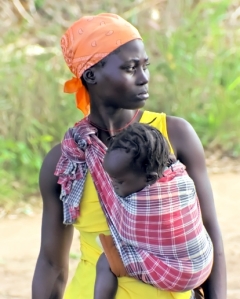
To the untrained eye, this is just another mother and child. To a Natural Childbirth Warrior? A living, breathing talking point.

To the untrained eye, this is just another mother and child. To a Natural Childbirth Warrior? A living, breathing talking point.

There are two kinds of “Women of Color.” The first is a resident of Africa City, a destitute woman from a non-specific brown country who barely has the energy to keep flies from the corners of her mouth. The second is the woman of The Ghetto in a “developed” country; poor, uneducated, just keeping her head above water, perhaps pausing occasionally to watch the asphalt grow.

The women of Africa City are noble. Unspoiled. Close to The Earth. They have much to teach us about The Old Ways, or they are lamentably, garment-renderingly out of touch with them. If they are out of touch, this has nothing to do with colonization or white racism (maybe just a little bit, but that’s in the past). If they are Close to The Earth, this is also because they have somehow escaped colonization and racism.

If you are a progressive in the Natural Childbirth Movement (or any other, for that matter), use Africa City women to promote the idea that “natural is better.” Talk about women who toil in the fields, squat down to give birth and return to picking rice. Or peanuts. Or anything else that can be picked. After all, the women of Africa City are resilient!  Strong. So strong that they do not even require support from the other women of Africa City. Or medication. Or comfort.  This example–of giving birth in the field–illustrates how over-reliant “we” have become on useless technology. Of course, you don’t expect “us” to be quite that strong.  We are not beasts of burden, after all. But from the comfort of our leather computer chairs, we can still make time to pay our respects to the women of Africa City for their unwavering and superhuman strength.

If you support natural childbirth or homebirth, use the women of Africa City to illustrate the point that birth usually goes well without medical intervention. Talk about the Old Ways. Quote white people who were made honorary princesses and priests by the women of Africa City. If you can’t quote those white people, quote white people who paraphrase those white people. Use Wikipedia.

If you oppose the Natural Childbirth Movement (or any other, for that matter), use Africa City women to remind “us” of how bad “we” used to have it, before all of our live-saving medical advances. If women die in childbirth in Africa City, it is only because they lack the Modern Technology we should be grateful that every last one of “us” has unfettered access to. Use infant mortality statistics from the most war-torn countries to argue why a healthy woman from Portland shouldn’t give birth in her bathtub with a midwife who carries oxygen and a cell phone. Redact all mentions of Africa City women who are not hopelessly impoverished. Ignore those who are systematically abused with Modern Technology, sacrificed as Guinea pigs on its altar. All bad outcomes in Africa City are due to the lack of Medical Technology, never unrelated to it, and certainly never caused by it.

No need to implicate colonization or white racism for the desperate state in which they find themselves. Be sure to use passive language.

The women of Africa City are pitiable. They wish for nothing more than to have access to all of “our” miraculous advances.  They spend every moment of their hunger-induced-hallucination-tinged waking hours praying for cold metal stirrups, off-label Cytotec and coin-flip-accurate fetal monitors mandated by legal departments. These wretched waifs need more access to things like emergency C-sections and Pitocin for post-partum hemorrhage, and they are willing to give up any semblance of autonomy and respect to get them. Because they are good girls who know their place. The women of Africa City, like other beasts of burden, are easy to control.

Now we come to the women of The Ghetto. Per the above, if you oppose the Natural Childbirth Movement, be certain to emphasize the fact that Ghetto women are not interested in this debate at all. They are too busy being fat and sassy so they don’t know nothin’ about birthin’ no babies. Their white teeth shine between fat, sassy lips as they cackle about them crazy white ladies who love them some homebirths! Ghetto women don’t care about how they are treated in “Western” hospitals. They’re just grateful they’re not in Africa City. Why they’re not in Africa City is best left undiscussed.

If Ghetto women are not sages in their own, simple-minded sort of way, then they are willfully ignorant, insolent, indolent and not worth including in any debate that requires higher brain function. That nearly everyone you encounter in the Natural Childbirth Debate seems to be white is clearly due to the fact it is not salient to the women of The Ghetto. Ain’t nobody got time for that!

Be sure to emphasize this indisputable fact no matter which side of the debate you fall on.  If you are a detractor of the movement, use it to underline how far on the fringe and out of touch the movement is. Use sexism to shame others for their racism. Make sure to point out that the nonexistence–well, as far as you’re aware, anyway–of Ghetto women on the side of the movement is indicative of how silly and trendy and insubstantial the so-called movement is.  Kind of like Brazilian waxes or platform wedges. If defenders get indignant, helpfully suggest that they’re probably premenstrual.

Pointing out that the movement is white is a particularly good strategy for a detractor, as “progressives” hate to be accused of not being “inclusive.” Never mind that you never, ever notice (or comment) on the dominating presence of whiteness in any other context. It’s fine to use it as a one-time strategy to discredit people you dislike, though you would balk if accused of something similar.  Your keen eye for racism is best suited as a rhetorical weapon against your white progressive enemies. Remain colorblind, should anyone bring up the fact that Ghetto women are far more likely to be subjected to unnecessary medical interventions during childbirth than white women. That’s playing The Race Card.  You’re the only one who should be doing that.

If you’re a supporter of the Natural Childbirth Movement, you, too, must concede that Ghetto women simply aren’t talking about childbirth. They have so many children and so many limitations, they are barely even aware that they give birth. Be sad about this. Use words like “regret” and “unfortunately” and other terminology that convey both a sense of sincere liberalism and futility. This will ensure that you don’t actually have to do anything about your own racism.  Your intentions are clearly good.

Defend yourself against accusations of exclusivity and whiteness with a two-pronged approach. First, offer proof of your complete and utter lack of racism. A Cherokee Princess great-grandmother may not be enough. A Mexican grandmother could work. Or time spent in the Peace Corps, preferably in Africa City. Second, argue that Ghetto women WOULD care about childbirth, they just don’t know they’re being oppressed. Talk about how you’re planning to educate them. Make the plan as vague as possible.  No need to follow up.

Then, as quickly as possible, recede into colorblindness. The very idea of race makes you uncomfortable. Which is why you don’t have one. If Ghetto women are not discussing these issues with white women, it cannot be because white women have dominated the conversation and alienated many of them.  White arenas are not white—they are just regular. Colorblind.

Someone may suggest that perhaps Ghetto women ARE discussing these issues—just in terms and contexts that were not created and defined by white people, thus rendering their discussion invisible. This is simply not possible.  Refer them to the tree and the forest.

(Don’t worry about the women of Africa City in all of this. They are either illiterate or too busy communing with The Earth to be a part of the discussion at all.)

Hopefully this guide has clearly demonstrated the correct use of women of color in the debate regarding Natural Childbirth Movement (or any other, for that matter). If the guidelines are too confusing, simply remember this: “women of color” are entirely theoretical. The word “women” is misleading.  They are not people– merely rhetorical strategies. Use them properly in service of your political agenda, and they’ll be sure to disappear entirely.

On bombasts and bullies.

This is yet another post I have wrestled with for days. Originally, this was to be another post about the follies of  performance feminism, in which I was going to invite women who build their brand on attacking other women (and my friends) to kiss every square inch of my beautiful brown ass. Because as much as I am tired of white feminists undermining and devaluing the work of WoC, I am really tired of certain self-serving WoC who use their bully pulpits to sabotage other brown women in the name of “sisterhood,” and have seen enough of that this year to last me a lifetime.

But ain’t nobody got time fo’ dat.

Besides, most takedown posts–no matter how honest–have little impact on the reputation of their targets. And they don’t make said targets any more remorseful or reflective. If anything, it adds to their legend. It lends credibility to their carefully crafted narrative. It turns villains into superheroes. Better to let them continue getting high from their own supply, to let them claim victimhood as they hide their own bloodied hands. Sooner or later, the mask will slip and people will see you for what you really are.

And with that, back to business.

Next Thursday (November 7), Hood Feminism–along with few of our friends–will be hosting our first Google Hangout on pro-blackness, respectability, and colorism. We’ll be kicking things off at 7pm EST. If you’re interested, come through. We’d love to have you.

Good Government Job, A Myth In Three Generations

My day job involves working for the federal government. My particular agency serves a vulnerable population, and as of this week most of my coworkers were deemed as essential. We’re part of that million plus going to work every day & hoping that we’ll get paid for it. Eventually. Like any job, I have a laundry list of complaints about my office even when the government isn’t shut down.  I don’t voice most of them in public (we are subject to all sorts of rules and in my position its easier to just steer clear of naming my agency at all), but I can’t resist the occasional bout of nondescript venting. This is not that. It could be, but really I’ve said enough, and recently I decided to leave my good government job. Because it really isn’t so good, and I’m tired of doing work I don’t love for a future that isn’t guaranteed.

I admit that like a lot of people of color, I was raised on the ideal of a Good Government Job. In my grandmother’s mind, a government job was the best anyone black could hope to achieve. You got a job with Uncle Sam or the state, county, or even the city and you stayed in it for 30+ years. It paid a living wage, and guaranteed a decent income in retirement. As the Holy Grail of jobs, it could come with any number of problems, and all of them would be worth it. You got your foot in the door and you stayed there. My grandmother preached the Good Government Gospel to her children and grandchildren. Mostly we listened, especially as it became clear that my grandmother’s friends with Good Government Jobs fared better financially than those without such exalted positions. Granted, my grandfather and grandmother never quite achieved that level of stability (they prospered from vice, small businesses, and a general ability to hustle), but then they were ones who went out to work young and who never had quite the same level of education and access that they sacrificed to obtain for their children.

Two of my aunts had Good Government Jobs that made it possible for them to sustain not only themselves, but my grandmother at times over the years after my grandfather passed and medical bills from his myasthenia gravis and my grandmother’s cancer ate up their savings. As state and city employees, they waded through rivers of red tape and came out the other side with some measure of stability. However, they are having two very different retirements. One aunt (a former state employee) is getting by on a fixed income that would have been comfortable pre-recession, and that is barely making ends meet now. The other (a former teacher and principal with Chicago Public Schools) is in better shape financially, but because Chicago teachers are excluded from social security, she is still working post retirement to make insurance payments until she is old enough to qualify for Medicare.  Neither of them are having the kind of retirement they were promised 30+ years ago.

Their retirements have been…instructive for me as I stare down the barrel of my second government shutdown. I’ve been essential both times (I was in the Army during the first one), and this time as I sit in a job that I hate for other reasons, I’m trying to imagine 30 more years of this kind of stress, as well as the chances that the promises being made now will be kept then. There’s this ongoing anti-government worker rhetoric that frames the services we provide as things that should be charitable donations.

The Good Government Job has long been the key to accessing financial stability for workers of color. I know more than one single parent who would not be in any position to care for their families without the benefits and pay offered. And make no mistake, despite the negative hype attached, government workers are doing important necessary work to run this country. But at what cost? Aside from the risks inherent in counting on a pension that may not exist, there’s the reality that government jobs don’t lend themselves to creativity.

Like a lot of us that grew up poor, I was always encouraged to think of writing or any other creative talent as a hobby. The Good Government Job was the best option, with a “real” job in the private sector as the second best option. Now, as I sit here with writing opportunities on one side, and furloughs and rhetoric on the other? I can’t help but think that the Good Government Job is dying on the vine, and just maybe it’s time to teach poor kids to reach for their dreams instead of wasting years on jobs that won’t keep their promises in the first place.  If we can’t have financial stability, at the very least we can pursue the things we love and hope that they can sustain us. What were you taught? What will you teach? Am I the only one that’s ready to give up on the idea of a single job being enough to pay the bills?

The Performance Feminist.

NARAL’s recent board appointment is just the latest in a series of “OH REALLY WTF YO?” moments in an already-fractured movement, another opportunity for a more inclusive approach falling away. Their new appointee’s failures at intersectionality have been well-documented, yet these missteps haven’t stopped her ability to fail upward.

Must be nice.

Though plenty of good people are on the front lines waging wars against “-isms” daily, social media has unwittingly given birth (and a considerable amount of real estate) to a new breed of feminist agitator–one who isn’t so much invested in fighting the good fight as she is, say, getting a spot on The MHP Show. She is lively, verbose and blustery; her showmanship could put the late P.T. Barnum to shame. She is…the Performance Feminist.

Equipped with a Twitter account, a WordPress blog, and an arsenal of quotes from Very Important Feminists at the ready, The Performance Feminist can be seen holding court in the public forum of her choice (though it’s usually Twitter.) She may be an academic from the Dirty South, or a charmed New Yorker with an Ivy League pedigree and a breadwinning husband. She may have cut her teeth writing about sexist tropes in Joss Whedon shows for a popular blog, or she may be a rookie, fresh out of her Women’s Studies class and ready to take on the world–in front of a camera, of course.

While The Performance Feminist claims to be all about fellowship and sisterhood, once she latches on to her cause du jour, civility and thoughtful engagement are on the midnight train to Georgia. Instead of reaching out for an honest conversation, she will man the torpedoes, taking to her blog to assail the characters of any and all perceived foes, real or imaginary. She will rally her troops to petition, boycott and march, all the while patting herself on the back for her good work. She will create conferences and collectives under the guise of sisterhood, all the while neglecting large swaths of girls and women who aren’t in the right age or tax brackets. She will take credit for creating online feminism when, in fact, it predates her involvement. When faced with legitimate criticism, she will dismiss it as jealousy and infighting, or respond with an ill-conceived plan to address the lack of diversity. She will shame and dismiss those who do not fit her arbitrary definition of Feminism, and will take to penning open letters to let her disapproval be known.

She will pay lip service to diversity and intersectionality as she readies herself for her new writing gig, where she will be counted on to offer the “feminist perspective” on a number of recycled, navel-gazing topics: Can a woman have it all if she takes her husband’s name while wearing skinny jeans? Are wearing skinny jeans feminist? What about wearing skinny jeans while watching porn? Meanwhile, other, more pressing matters receive scant attention.

The Performance Feminist never shies away from a topic, even if she doesn’t know much about it. Image is everything; as long as she appears informed no one has to know that her treatise on Chicago violence was based on one interaction with a homeless guy at a Harold’s Chicken while in town visiting a beau. People will praise her for passion and bravery, for her commitment to make the world a better place. It will make her big television debut that much sweeter.

Which is great. For her. The movement, not so much. These antics drown out other voices, like the ones rallying to save broken public school systems across the country, or the ones fighting on behalf of indigenous rights. Or the ones working to improve the conditions of mothers everywhere, working and non. It means little-to-no shine for issues affecting millions of people who don’t live in New York City, whose only means of online access may be through a prepaid cellular phone. It means that the people most at risk will continue to be overlooked.

So how does one avoid being a Performance Feminist? As the famed poet Dewayne Michael Carter once said, Real Gs move in silence, like lasagna. Let your work speak for you. When advocating on behalf of those who cannot speak for themselves, remember that they are human beings, not a cause to be advanced; let them tell their own stories in their own words. Use your online platform to facilitate discussions in good faith. If someone calls you out, graciously accept the criticism and learn from it. Talk less. Listen more.  Don’t let your naked ambition alienate those who could potentially change the world.

Of course, all of these things have been said before. But a little reminder always helps.

Why the government shutdown is a feminist issue.

When the clock struck midnight on Capitol Hill, nearly 9 million mothers and children were left to fend for themselves, their WIC support suspended. Since there was no approval for additional funding, the 53% of American infants and 25% of expectant mothers currently covered by the program will stop receiving clinical care and food benefits in the next week or so, unless the states can pony up. (SPOILER ALERT: Most of them can’t.)

And with women making up 44% of federal employees, this infographic (courtesy of WaPo) illustrates how many could be left in dire financial straits as the shutdown continues.

People in need of emergency assistance won’t be able to rely on TANF, either. (h/t @AmandaMichelle)


We’ll start posting whatever information and resources we stumble across here.

Feeding America has a few ways to give.

Or check out Catholic Charities.

Or this national food bank directory.

The National Association of Free and Charitable Clinics can help you find a clinic in your area. And they’re in need donations and volunteers.